
Before you
replace it.
Let us find out what is actually wrong. Central vacuum systems, uprights, canisters, premium machines—and the weird old stuff too.
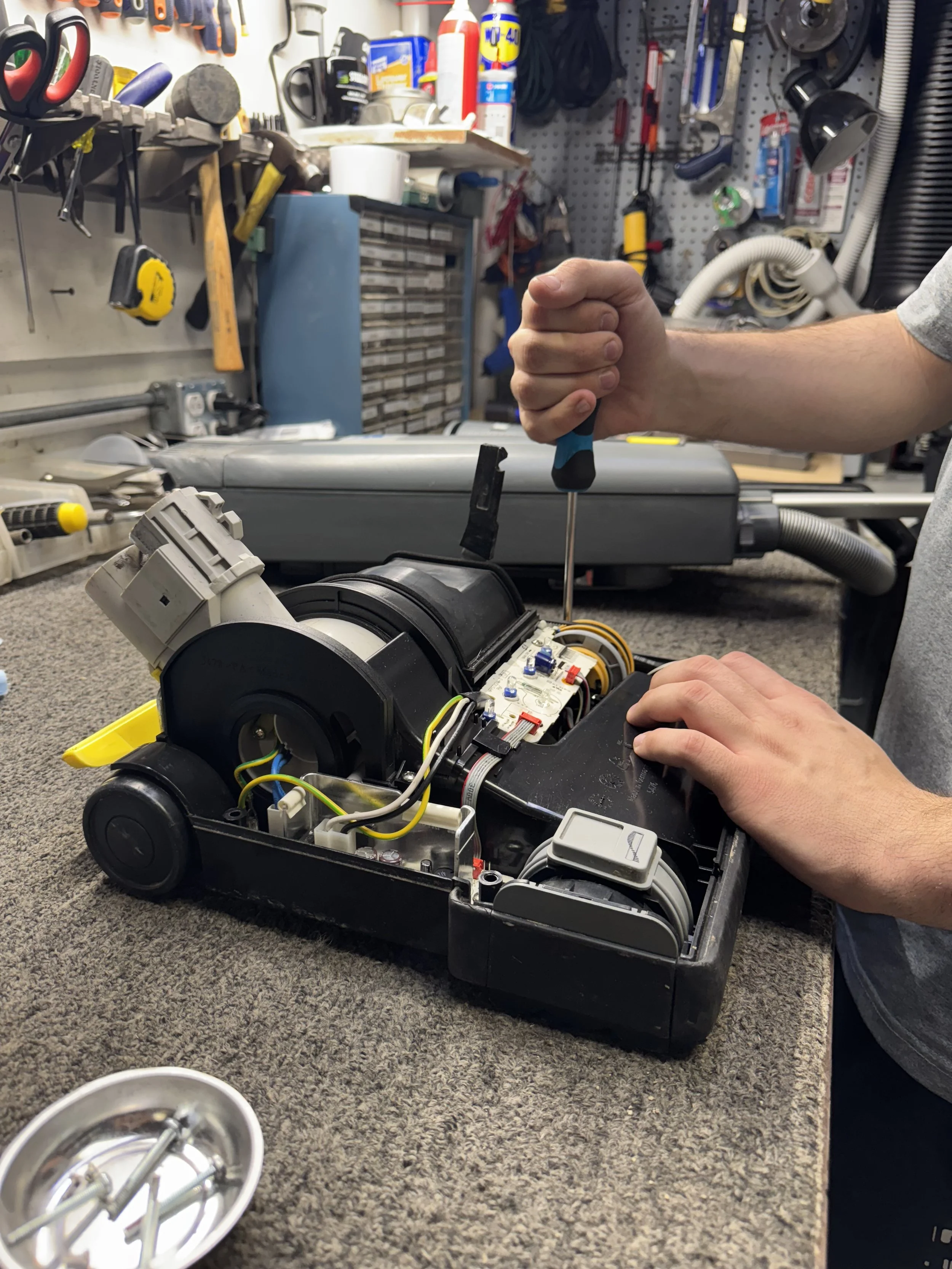
We open things.
We test things.
We fix things.
Not every vacuum problem needs to end with a new vacuum.
Many machines can run for years—or decades—with proper service. When parts are available and a repair makes sense, we want to keep good equipment working.
What is it
actually doing?
A symptom helps us narrow the possibilities. Pick the closest match—or just call us if you would rather talk it through.
Weak everywhere, gradually weaker, or poor pickup.
→ 02 Won't RunNo motor response from the hose or wall inlet.
→ 03 Won't Shut OffPower unit runs continuously or behaves intermittently.
→ 04 Only Some Areas WorkOne inlet, one floor or one section behaves differently.
→ 05 Strange NoiseMotor sound, vibration, brushroll noise or something new.
→ 06 Possible ClogSudden restriction, blockage or dramatically reduced airflow.
→ 07 Old SystemDiscontinued equipment, odd inlet, unknown brand. That's okay.
→ 08 None of These?You don't need to diagnose it before calling us.
☎
Diagnosis before parts cannon.
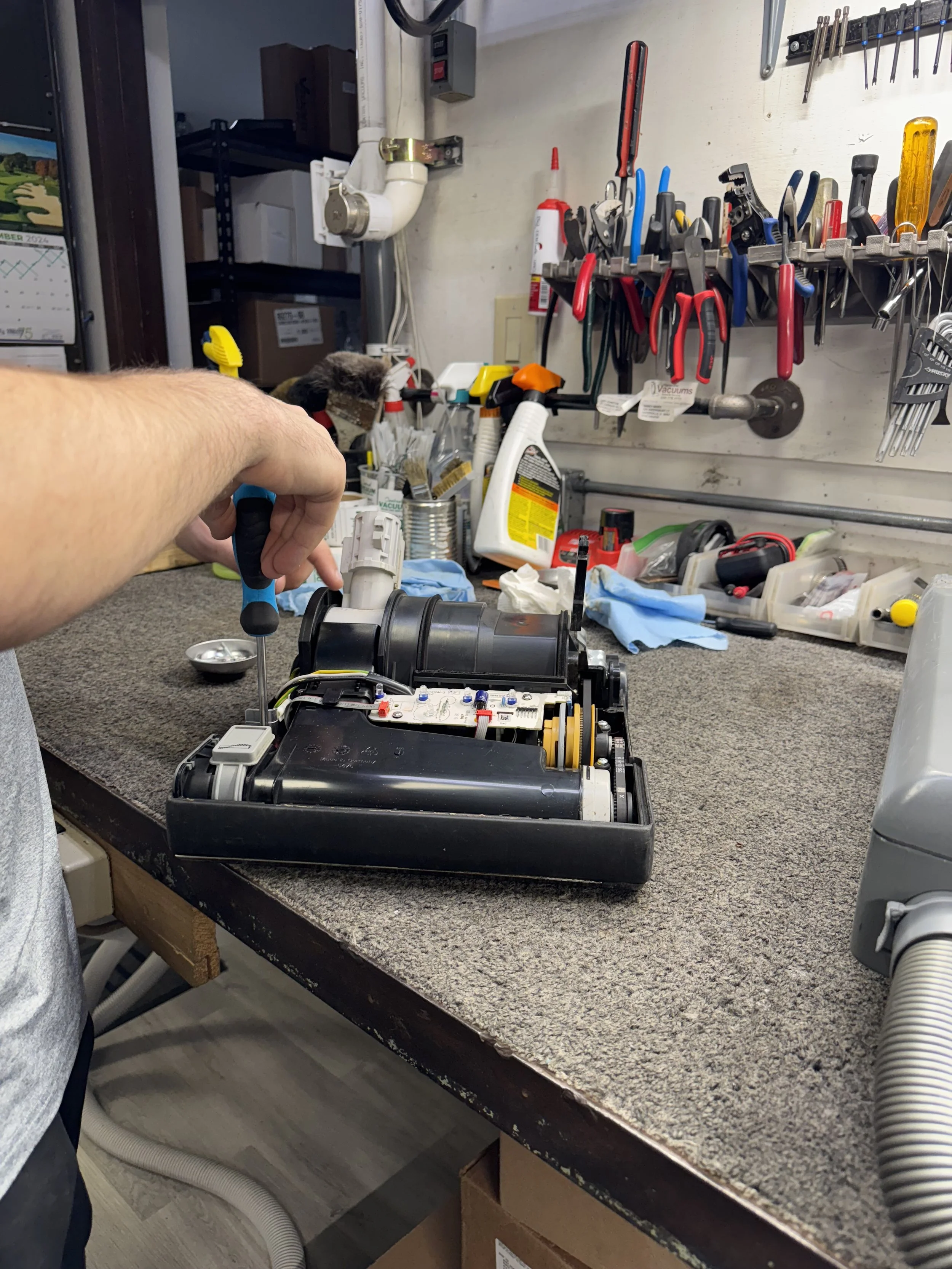
A proper repair starts by identifying the failed component and determining whether it is the cause—or only another symptom.
Bring us the
whole machine.
Uprights, canisters, bagged machines, bagless machines, premium vacuums, household workhorses and equipment somebody else already gave up on.
Schedule a repair →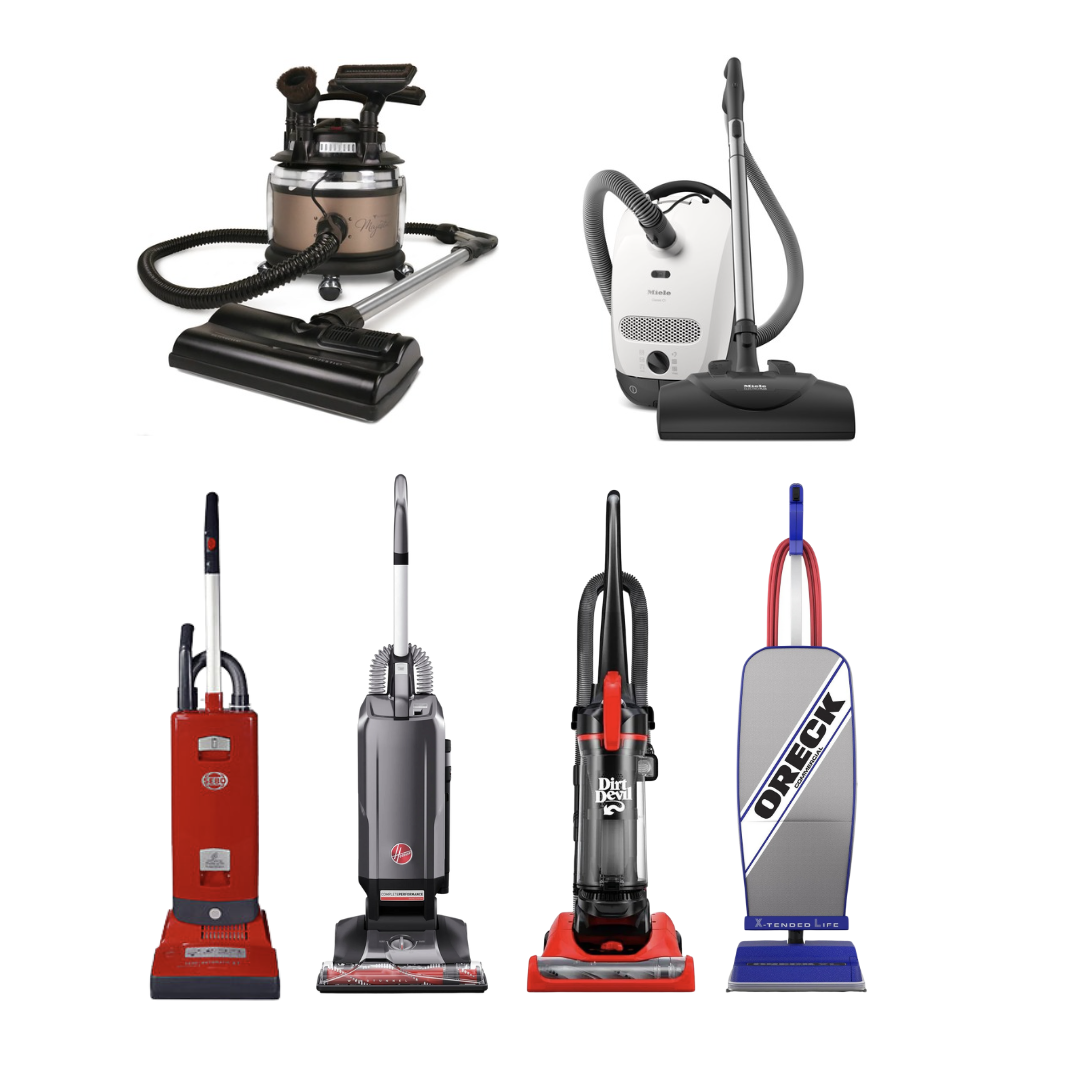
Before you
load it in the car.
The questions people actually ask us before bringing a vacuum in for service.
01 Should I repair my vacuum or buy a new one?
Many vacuums are designed to run for years or even decades with routine service. If parts are available and the machine is worth maintaining, repair may make far more sense than replacement.
Let us inspect it →02 How long does a repair usually take?
Turnaround varies with the repair and parts availability, but three to six business days is typical.
Ask about current turnaround →03 I don't know what's wrong. Can you inspect it?
Absolutely. There is no charge for a preliminary inspection. When necessary, a more thorough bench teardown and diagnosis is also available.
Schedule an inspection →04 Do you repair brands you don't sell?
Yes. Central Vacuum services a broad range of portable and built-in vacuum brands, including many manufacturers no longer commonly supported by ordinary vacuum retailers.
View brands we service →05 Do you offer pickup or delivery?
Pickup and delivery may be available. Call us so we can discuss the machine, location and current options.
Call 630-608-0175 →06 What should I bring with the vacuum?
Bring the machine and the components involved in the problem. If the issue occurs only with a hose, powerhead, charger, wand or attachment, bringing that component helps us reproduce the fault.
07 What if parts are discontinued?
That does not automatically end the conversation. Depending on the machine or system, existing parts, compatible replacements, repairs or modernization may still provide a practical path forward.
A whole-house vacuum is a system.
Motor. Controls. Hose. Inlets. Tubing. Filtration. Attachments. Every part affects the result.
Air has
to move.
Cleaning performance depends on airflow, pressure, restrictions, filtration, hose design, piping and the cleaning tool—not one marketing number.
Read Owen's Vacuum Measurements article →Good. We like history.
CentVac's own technical archive spans decades of central-vac equipment, including systems whose original manufacturers have long since changed, consolidated or left the vacuum business entirely.
CentVac maintains knowledge and parts support for old Filtex installations and regularly services legacy systems across Chicagoland.
Repair.
Refresh.
Replace.
Correct the failed part and put useful equipment back into service.
Upgrade the hose, tools, filtration, power unit or controls while keeping the useful infrastructure.
If repair cost, parts availability or performance makes replacement the better decision, we'll tell you.
The walls usually aren't the problem.
Central vacuum service sounds intimidating because part of the system is hidden. In practice, many common failures can be isolated without opening finished walls.
Full Central Vacuum FAQ →01 If a pipe clogs, do you have to cut the wall open?
Usually not. Many obstructions occur in the hose, near an inlet, or can be cleared using service techniques without opening finished walls.
02 Why does one inlet work better than another?
A difference between inlets is useful diagnostic information. It can help isolate an issue to a branch of tubing, an inlet, a seal or another localized part of the system.
03 Can an old central vacuum be upgraded?
Often, yes. Good piping can remain useful long after the original power unit, hose or accessories have reached the end of their service life.
Explore retractable hose upgrades →04 What if my inlet isn't a modern standard size?
Older systems sometimes use proprietary inlet designs. Identifying the system correctly is the first step; adaptation or modernization may be possible without abandoning the entire installation.
Explore the CentVac Guide →
Just tell us
what happened.
Bring the machine. Tell us what changed. Show us the noise if you recorded it. Tell us which inlet works and which one doesn't. We'll take it from there.